Monday, May 27, 2013

Rio de Janeiro: About the City

Hello everyone!
This week we will talk about this marvelous city called Rio de Janeiro. Let's learn about the city, the cariocas, the local culture, talk about hotels, restaurants and a lot more. Did you know that Rio awarded UNESCO World Heritage Status in 2012 because of its landscape? Well deserved! 


Rio de Janeiro is the capital of the state with the same name, located at southeast of Brazil the city is formed by rocky mountains, forests, and beautiful world famous beaches. It has over 6 million inhabitants, being the second largest city of the country. The residents of Rio are called cariocas, which are known for their lifestyle, for enjoying the beach like anyone else in the world, for their constant good mood and for the pride of their beautiful city. Among the notable cariocas who have made a difference in the world's history are: Ronaldo (football player), Tom Jobim (musician), Walter Salles (film director), Paulo Coelho (writer), Oscar Niemeyer (architect), Chico Buarque (singer, composer, songwriter), and Nelson Piquet (Formula one driver).

Rio used to be the capital of Brazil until 1960, and is the main destination for tourists, maybe that's why so many people still believe Rio is the capital. Besides the tourism, the industrial activities are also very important for the economy in Rio. The Campos Basin produces the most of the total petrol produced in the country. Important national companies such as Petrobras, Vale and the telecom company Embratel are located in Rio. The city has also many universities such as the Federal University of Rio de Janeiro (UFRJ), Getulio Vargas Foundation (FGV), Pontifical Catholic University of Rio de Janeiro (PUC - Rio), among others. 


In 2014, 32 nations will enter the final tournament with the 64 matches being played 12 different venues across this vast country. Rio will host 7 games including the finals, at Maracanã stadium, better known as Maraca. The stadium of Maracanã was built in 1950 for the FIFA World Cup Brazil and was the largest stadium in the world, it has received a crowd of up to 200,000. For the 2014 World Cup it had it's capacity reduced to less than 77, 000. In June, Maracanã will also host 3 games at the Confederations Cup. 

Watch the video made by FIFA to show what Rio has been making to host the Confererations and World Cups.

2014 FIFA World Cup Brazil Magazine - Episode 1

By the time the video was made Mano Menezes was the Brazil's national coach, but in November 2012 he was substituted by the 2002 World Cup winning coach Luiz Felipe Scolari, known as Felipão, right after assuming the national team he declared: "We have no choice but win this World Cup".


Come to visit us! We are waiting for you!

Saturday, May 25, 2013

Songs: Ivete Sangalo

When Ivete was the Banda Eva's leader and vocalist, from 1993 to 1998, the band sold more than 3,75 million copies, in 1999 she left the band and since then the success of her solo career only increased, and she became the biggest Brazilian artist. Ivete is the queen of carnival in Bahia, a singer, songwriter, and actress who connects with her fans in a way that no other artist can do. She calls them by their names, meet them after her concerts, she is the most charismatic artists you've ever seen. That's why she became so famous and so loved by Brazilians and her international fans. 

oficialivetesangalo
In 2007 Ivete performed at Maracanã to over 50 thousand people to record her DVD "Multishow ao Vivo - Ivete no Maracanã", it was the best seller DVD of 2007 in the whole world, selling more than 600 thousand copies.  Here you can watch her singing Corazón Partío with the renowned Spanish artist Alejandro Sanz.


In 2010 Ivete performed at Madison Square Garden to 15,000 people. On the day after her performance The New York Times published: "She was indefatigable onstage, doing fast samba footwork in high heels through a three-hour set". 
Watch her performance at The Garden:


"Ms. Sangalo strutted through the routines of an arena diva with spirit. Yet after the confetti shower and the big exit — ascending with a bunch of balloons — she came back for another unchoreographed half-hour that was thoroughly Brazilian and the best part of the concert. With her band somehow picking up cues amid the crowd, she vaulted through a half-dozen carnival songs, full of references to the streets and neighborhoods of Bahia’s capital, Salvador, with the whole arena singing along. Even in New York she was playing to a home crowd". (The New York Times)


Thursday, May 23, 2013

Brazilian Football

Hello dear readers!
You all know that the amazing Spain has won the last World Cup in South Africa, and that Italy has won the 2006 World Cup in Germany... 
Take a look on the most recent FIFA's ranking*:

  1. Spain
  2. Germany
  3. Argentina
  4. Colombia
  5. Belgium
*updated on October 18, 2013

Brazil is not even on Top 10... so what makes Brazil always a favorite? What makes Brazil so special when we talk about soccer / football?


Brazil is the only country to win the World Cup 5 times, the only country to be present in every single edition. On Fifa's all-time ranking Brazil is still the number one, followed by Italy and Argentina. Have you heard names such as Ronaldo? Rivaldo? Kaká? How about Pelé? Yes you sure have, and you have heard many other names because Brazilians have always been among the best players in the world. Football is by far our biggest passion, our most popular sport. Our players are serious about winning, but not so serious after every goal scored! They love to perform dances, create different choreographies to each game, they are always smiling, showing the world the beautiful game. Football has the power of uniting people from different backgrounds, it reflects the happiness that is always present in our lives. 
Brazil has always been a happy place on Earth, and lately it has shown that is also synonym of progress, opportunity, and stable economy. Brazil is modern, and diverse. We are ready to host amazing events starting next month up to the following years and you are invited to come to our country and celebrate with us.

Friendly Games:

Next game: June 3rd, 2014
Brazil x Panamá at Serra Dourada - Goiânia

Next game: June 6th, 2014
Brazil x Serbia at Maracanã, Rio de Janeiro
Buy your tickets at totalacesso.com.br

The video below shows how Brazil got their famous uniform.


Wednesday, May 22, 2013

Catholic Churches Worth Visiting

On July 22nd the Pope Francis comes to Brazil on his first official international travel for the Apostolic Journey. In Brazil over 120 million people follow the Roman Catholic religion, more than any other country in the world. Today I will show you the amazing churches you can't miss.

Rafael 1984 on Flickr
National Shrine of Our Lady of Aparecida - Every year over 9 million people visit this Shrine which is the second biggest of the world, smaller only than the Saint Peter Basilica at Vatican. in 1717, when the city was lacking food, three fishermen fished, as a miracle, the image of Virgin Mary from the Paraíba do Sul River, a sign that the city of Aparecida would be blessed. From that time on Aparecida became a religious destinatination for Brazilians and international tourists.  Address: Av. Júlio Prestes, Aparecida - SP. Distance from São Paulo: 188 km, from Rio: 269 km.


Cathedral of Brasilia
Cathedral of Brasilia - one of the most famous projects of the architect Oscar Niemeyer, the Cathedral has 16 columns that meet in the center and separate again on top. It started to be built in 1958 and was finished in 1970. 
Part of the Cathedral was built bellow the ground level, so from inside it looks bigger. Address: Esplanada dos Ministérios, lote 12 - Brasilia, DF. Hours: Mon - Fri 8 am to 6 pm / Sat 8 am to 5 pm / Sun 8 am to 6 pm

Cathedral of Sé - The beautiful Cathedral in gothic architecture style is located in the centre of São Paulo city, it's construction started in 1598 and finished in 1612. The dates are impressive considering that Brazil was discovered in 1500, but in 1954 the Cathedral was totally remodeled. Address: Praça da Sé - São Paulo, 01001-000 Hours: Mon - Fri 8 am to 7 pm / Sat 8 am to 5 pm / Sun 8 am to 1 pm and 2 pm to 6 pm. For more information visit: Catedral da Sé.

Mosteiro de São Bento
Mosteiro de São Bento - The first construction is dated 400 years ago, but this beautiful, huge construction you will see is the forth one, from 1922. The project was made by Richard Berndl, professor at the University of Munich, one of the best architects in Germany. On the last Sunday of each month, after the mass you can stay for brunch, the food is prepared by the monks and good chefs from São Paulo. To buy the tickets please call +55 (11) 2440-7837 talk to Silvia. You can also buy bread, pastries at the Mosteiro's bakery, or online, check the website: Bakery   Address: Largo de São Bento (Centro) - São Paulo.


São Francisco de Assis

Church of São Francisco de Assis - At Pampulha, Belo Horizonte, both the church and the region are worth visiting. The chuch was projected by the famous architect Oscar Niemeyer in 1940. Inside you will admire the paints of Portinari. Address: Avenida Otacílio Negrão de Lima, 3000 - Pampulha - Hours: Tue - Sat and holidays from 9 am to 5 pm. Sun 12 pm to 5 pm. Sunday mass: 9:30 am.

Catedral Basilica - It is said that the city of Salvador, Bahia has over 365 churches. The Basilica Cathedral is the most impressive of the city, it has golden altars on the side, rich in details. Pay attention on the celling made of tridimensional images. Address: Terreiro de Jesus (Pelourinho) - Hours: Mon - Sat 8:30 am to 11:30 am / 1:30 pm to 5 pm. On Sundays it's open only for masses, at 9 am and 6 pm.
Church and Convent of Sao Francisco


Church and Convent of São Francisco - this church impresses for the amount of gold it has all over the place. It was build with the financial help of the Portuguese King and Christian followers. The church has a baroque style, very rich in details; the marble floor imitates rugs. Avoid visiting the church at mass hours (Tue at 7, 8 am and 4, 6 pm / Wed and Thu 7:15 am and 6 pm / Fri 7:15 am / Sat 7:30 am / Sun at 8 am), it's free but it's not allowed to walk around and take pictures. 
The church is open on Mon from 9 am to 5:30 pm / Tue 9 am to 2:45 pm / Wed - Sat 9 am to 5:30 pm, on Sundays is necessary to book a visit. It costs R$ 5.00 (around US$ 2.50). Address - Largo Cruzeiro São Francisco - Pelourinho - Salvador

São Francisco da Penitencia - Creative Commons/Enrique Lopez Tamayo Biosca
Igreja de São Francisco da Penitencia - If you are in Rio, this is a church worth visiting. When you look from outside you can't tell how impressive it is inside. 
The church has a baroque style, from the front door, you can take a nice a picture. Address: Largo da Carioca - Centro - Rio de Janeiro. Hours: Mon - Fri 9 am - 12 pm /  1pm - 4 pm.

Nossa Senhora do Carmo da Antiga Sé - Also in Rio, this church has lot of historical importance. It was there that occurred the consecration of Dom João VI as King of Portugal in 1816, and Dom Pedro I and II as Emperors of Brazil. 
To learn more the Sound and Light click here, screw the page down to read it in English. Address: Rua 7 de setembro, 12 - Centro - Rio de Janeiro. Hours: Mon - Fri 7 am to 4 pm / Sat and Sun 9 am to 12 pm.       
Nossa Senhora do Carmo da Antiga Sé - Flickr: LL Silva


Tuesday, May 21, 2013

Beach Culture: Beach Soccer

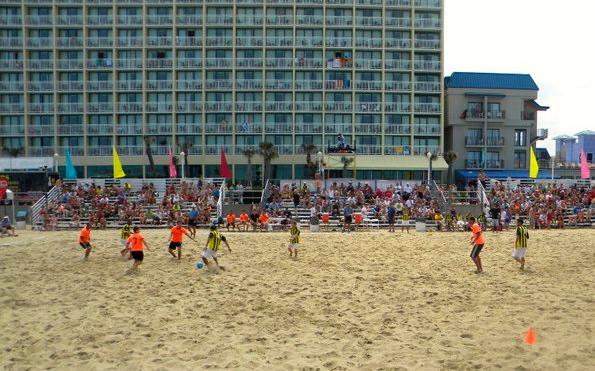
Hello everyone! As we saw on my last posts Brazilian have invented many fun sports such as futevôlei, frescobol, and capoeira. Did you know that beach soccer was also invented here? Yes, it was. It started in Copacabana beach and is now played in 75 countries.
globoesporte.globo.com
The beach soccer started to be played in 1992 in Rio and in 1996 the first Pro Beach Soccer Tour was organized in Europe, Asia and US. The sport quickly became very popular, in May 2005 FIFA decided to take over and organized the first FIFA Beach Soccer World Cup in Copacabana, Rio de Janeiro, when France was the winner followed by Portugal and Brazil.
beachsoccer.com
The game is played on the fine sand, at least 40 cm deep, free of shells or anything that may hurt the players. The court has 35-37 cm  length x 26-28 cm width. The match is played by two teams of 5 players each, including the goalkeeper. The number of substitutions are unlimited and the player who was substituted can return to substitute another player. The players are allowed the wear only a jersey, and shorts, an elastic binding to protect the feet may be worn too, but no footwear is permitted. The goalkeeper can wear long pants and gloves.


The match has three periods of 12 minutes each, this game requires excellent physical conditioning, skills and ability and usually many goals are scored in each match. It's a beautiful game to watch. Hope you enjoy it!

Sun, Sand, Sea, Soccer, Sweat... the perfect 5 S! 
Does anyone want to Swim? Sure! See ya!